Press and possess: Spain's secret sauce is a suffo...
📰
ESPN Soccer
📅
17 Jul 2026 20:04
🏷
football, fifa world cup, soccer
Summary
Spain are known as the modern purveyors of the beautiful game, but what has got them to within 90 minutes of another World Cup win is an elite defense.
Spain used to be a nation of soccer underachievement, one that could produce spectacular teams at the club level and had plenty of talent but fell short at the highest international level.
They won an out-of-nowhere Euro 1964 title thanks to Chus Pereda, Luis Suárez (the original one) and a pretty easy draw. But in the 42 years that followed, they made it past the quarterfinals of just one major tournament. But they've won four major tournaments in the past 18 years, and in Sunday's FIFA World Cup final, they'll have a chance to make it five in five finals appearances in that span. (If you're a "The UEFA Nations League is a major tournament, too!" person, add another title and three more finals appearances to that tally.)
Spain got to the World Cup final as the anti-Argentina. They don't create increasingly elaborate straightjackets to Houdini themselves out of, and they don't pursue drama and emotion at all times. They simply win. They control the ball, they play some of the most complete defense the World Cup has ever seen, and at some point they get around to scoring a winner. Sometimes it happens early -- they went ahead for good in the 10th minute against Saudi Arabia, 22nd against France, 36th against Austria and 42nd against Uruguay -- and sometimes Luis de la Fuente has to smash the emergency Mikel Merino button. (Merino scored winners in the 88th minute against Belgium and the 90th+1 against Portugal.) But even in those late thrillers, the moment was muted by the fact that Spain never really looked like they were going to lose.
Through a disappointing start, the underdog-driven group stage, France's bursts of brilliance and Argentina's aforementioned thirst for drama, Spain, the pre-tournament favorite, somehow reached the final almost under the radar. But while Argentina have the GOAT, France have the glamour and England have the Premier League in their backyard, Spain enter Sunday as the favorites to take home the World Cup title. Through perfect defense, a perfectly crafted system and the perfect choice to top the org chart, they have a chance to reinforce their status as the world's best footballing nation.
The closest you can get to defensive perfection
There are basically two ways to produce excellent defensive numbers. If you have the talent to deploy a strong, modern possession game, you can tilt the pitch in your favor, keep your opponent as far away from your own goal as possible, counterpress in all the typical, effective ways and basically prevent your opponent from generating any sort of shot quantity whatsoever. With varying degrees of risk and aggression, this is what nearly every rich, successful club tries to pull off in mid-2020s club soccer.
If you can't do that, there's Option B: Create a nice, cluttered box, allow your opponent as many hopeless long-range shots as they could possibly want, and spend 90 minutes making sure they don't get a single, clean look at the goal. This was the approach we saw from quite a few successful World Cup underdogs, and it's one of the tenets that allow overachieving clubs like Athletic Club to, well, overachieve.
Spain have figured out a third option at the World Cup: do both brilliantly.
Spain rank first among the 48 World Cup teams in both shots allowed per possession and xG allowed per shot.
They help themselves with an excellent pressing game -- they rank first in percentage of their possessions starting in the attacking third (12.1%), third in high turnovers forced (12.9 per 90 minutes) and third in passes allowed per defensive action (9.0). They give opponents little peace, and their defense starts up top with particularly solid contributions from center forward Mikel Oyarzabal and winger Álex Baena, neither of whom was chosen for their roles because of extreme scoring capabilities. And with their strong possession game (they're third in possession rate, at 63.7%), they can operate with a nice, high defensive line and consistently draw opponents offside (3.3 times per 90, fifth overall).
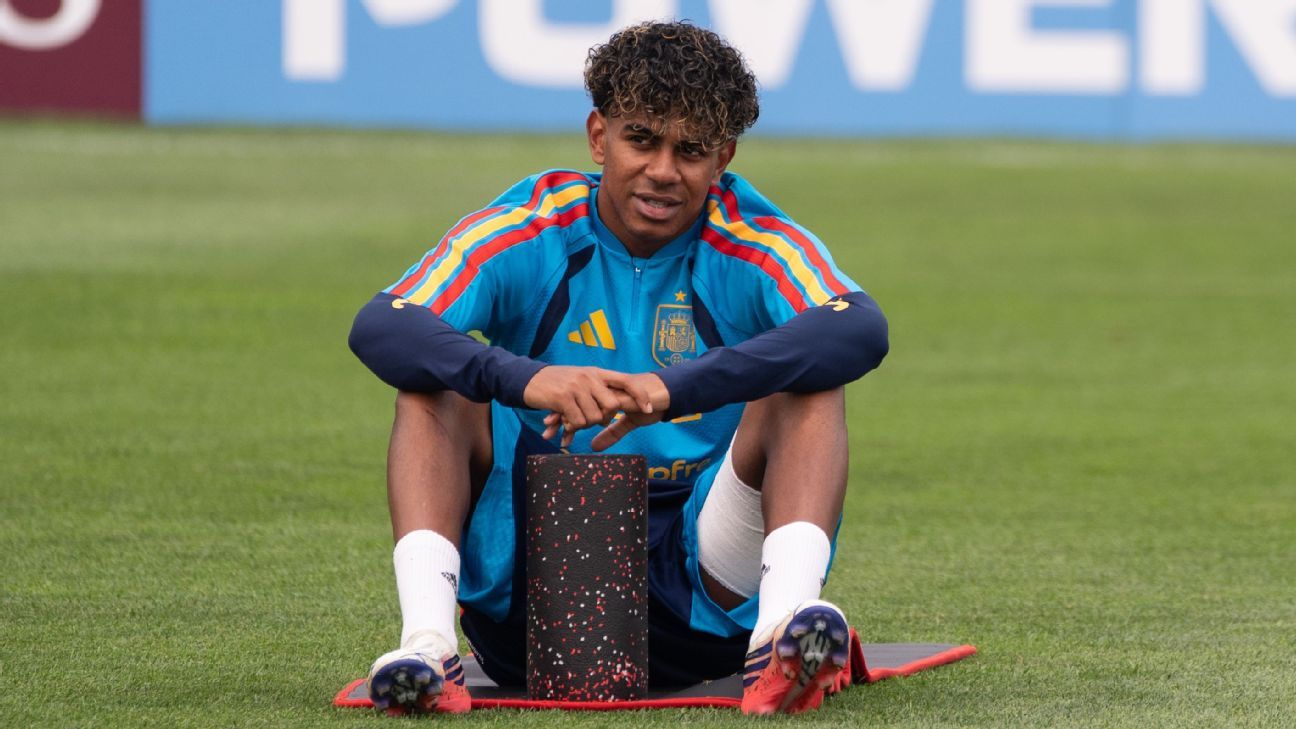
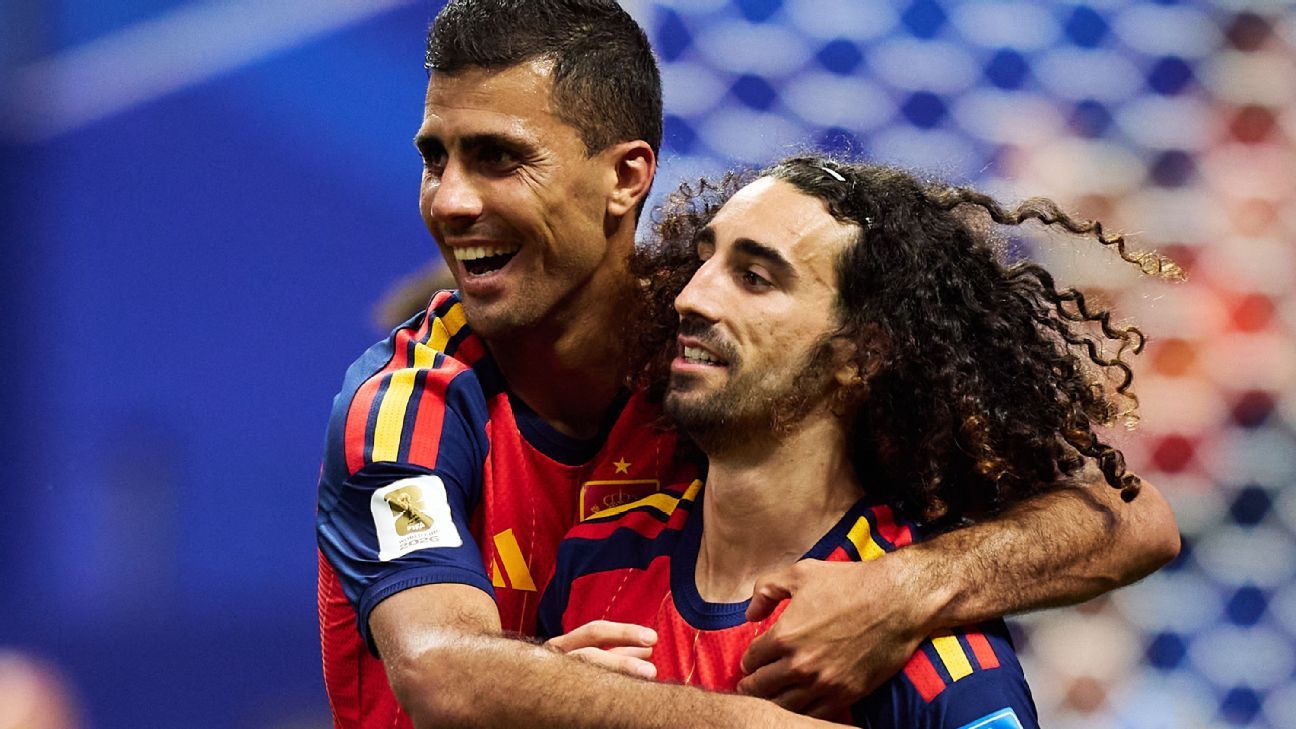
For a team pulling all 26 of its players from the rosters of clubs in Europe's Big Five leagues -- including eight from the most pressing- and possession-intensive club on the continent (Barcelona) -- it makes sense that Spain would thrive in this area. Key attackers Lamine Yamal and Dani Olmo are Barça constants, as are midfielder Pedri (relegated to a bench role of late) and center back Pau Cubarsí. Defensive midfielder Rodri, meanwhile, won a Ballon d'Or and 13 trophies with Pep Guardiola's Manchester City. Of course they press and possess well. But the fact that Spain have also played perfect transition defense and have mastered the rare defensive intervention as well has taken them to a different level.
It was easy to frame Spain's semifinal against France as one of tension between two styles: Spain would attempt to dominate the ball but would leave space behind them that France's devastating and speedy attackers would attempt to exploit. But Spain removed any tension by quickly intervening in almost every transition attempt.
For the tournament, Spain rank just 46th in defensive interventions per game (55.4), which makes sense, as they usually have the ball. But while defending a lead for nearly 70 minutes against France, they traded a little bit of initiative for interventions: They made 71 of them in all, getting 10 from Cubarsí, nine each from right back Pedro Porro (who also scored the team's second goal) and defensive midfielder Fabián Ruiz, eight each from center back Aymeric Laporte and left back Marc Cucurella and seven from Rodri. Rodri also won a staggering 11 of 16 duel attempts (68.8%), while Porro and Cucurella won a combined eight of 13 (61.5%), Ruiz won five of seven (71.4%) and Cubarsí and Laporte won a combined five of seven, too. All together, that's a 67.4% winning percentage against a technically brilliant and athletically gifted French attack.
France couldn't find much space, and when they did, it disappeared quickly. And late in the match, as Spain were trying to see out their two-goal lead, they proved they could bunker in and get bodies in front of the goal as well. France finished the match with just 10 shot attempts; none were worth more than 0.06 xG, only one was attempted within 14 meters of the goal and only three made it to goalkeeper Unai Simón, who saved each with ease. Spain defenders even blocked two of the shots, along with 18 passes. It was probably the most perfect defensive performance of the tournament.
Club underachievers, country stalwarts
On one hand, it shouldn't be a surprise that this group of defenders could be capable of playing this well -- all either play or played for some of the biggest clubs in the world: Paris Saint-Germain (Ruiz), Manchester City (Rodri and, until 2023, Laporte), Barcelona (Cubarsí), Chelsea (Cucurella) and, if they still count, Tottenham Hotspur (Porro).
On the other hand, Rodri has spent the past two seasons attempting to rediscover his Ballon d'Or form after an August 2024 knee injury. Laporte spent two seasons with Al Nassr, then played 2025-26 with a disappointing Athletic Club. Simón is Athletic's goalkeeper and, according to many, Spain's second-best keeper behind Arsenal's David Raya. Cucurella has spent the past couple of years as one of the faces of a Chelsea team that can't decide on a coherent playing or roster-building philosophy, although when he leaves North America after Sunday's final, he'll join up with Real Madrid. Ruiz started only 13 league matches for PSG in 2025-26, spending much of the season sidelined by injury. Cubarsí is outstanding for a 19-year-old but is still young for a position that traditionally requires longer development.
Throw in players like Real Sociedad's Oyarzabal (nine non-penalty goals in all club competitions last season) and Atlético Madrid's Baena (just two goals and three assists in 2,305 club minutes), and you don't get the impression that this is a team built around the most brilliant, in-form club players in the world. And despite Yamal's relentless, duel-winning presence on the right wing, Spain are only 13th of 48 teams in goals per 90 minutes (1.86) and 18th in xG per shot (0.15). But they're first in goal differential (+1.7 per game) and first in xG differential (+1.6) because the pieces fit the system perfectly.
"I've always said this footballing model is tailor-made for this group of players," De la Fuente said after Tuesday's semifinal victory. "We know exactly what they can offer and how they can improve this style of play, but the credit belongs to the players. Our job is to choose the players who best fit this model and this philosophy."
It hasn't hurt that Rodri has become full-on Rodri again. For the occasional uncertainty he showed with City last season, he's now nearly two full years removed from his injury and has been sure-footed and note-perfect all tournament. In terms of creativity, he's second on the team in chances created (nine); in terms of buildup and possession, he's first in touches (794), passes completed (655), passes received (580), progressive passes (81), carries (556) and carry distance (2,426 meters); in terms of defending, he's first in successful tackles (22) and ball recoveries (34) and is second in ground duels won (30). He's playing about as well as he ever has.
"Rodri is the axis of the team," De la Fuente said. "He's the positional reference point who does everything well. He understands attacking football brilliantly. He plays with very few touches. He breaks lines with incredible ease. Defensively, his positioning gives the team balance. He wins back countless balls. He's unquestionably one of the most important players in our system. We're fortunate to have footballers like him."
The doting dad in charge
At this point, it's difficult to imagine anyone else more accurately and thoroughly representing Spain's footballing philosophy than De la Fuente. The 65-year-old has spent the past 13 years with the Spanish federation, first coaching the U19 team before moving up the ladder; he has internalized and implemented their playing style as much as almost anyone.
In the decades before that, though, he was a master of a grittier and more defensive type of Spanish ball. He started 196 times for Athletic Club in the 1980s and early-1990s; the famous Butcher of Bilbao match, in which Andoni Goikoetxea broke Diego Maradona's ankle, De la Fuente was on the pitch for 50 minutes that day. He looks like a college professor, but he played during one of the sport's most brutally physical eras.
De la Fuente played for Athletic (twice), Sevilla and Alavés, then coached at Athletic and Alavés before joining the national federation. He knows Spanish football backward and forward. And in his news conferences, he almost comes across more as a proud papa than an exacting coach. When asked about the King of Spain calling after their win over France, he called it a "tremendous source of pride ... to know that we've helped bring joy to an entire country that has come together in the streets behind this team." He returned to the idea of joy often, later saying, "There's no greater joy than seeing other people happy. That's what motivates us."
When asked about the group's secret sauce, he talked at length, not about tactics, but about roommate selection.
"I think the most important thing is choosing your travel companions wisely," he said. "If you choose the wrong people, the journey becomes difficult. We've always paid a lot of attention to that. Not just the players, but everyone who forms part of this group works toward the same objective. ... We've spent 47 days together, if I'm not mistaken, and there hasn't been a single problem. But again, the key is choosing the right people to travel with."
(For his part, Argentina head coach Lionel Scaloni is cut from similar cloth. The night before their quarterfinal against Switzerland, he talked at length about the importance of bonding and life experiences. "I'm not a coach because I love the 4-3-3 formation," he said. "I'm a coach because I want to experience moments like these again -- being part of a group, sharing mate, having an asado, playing Truco. That's what we've done our whole lives. If all you ever think about is the match, the match, the match, you eventually burn yourself out. If you don't enjoy everything around it, then what's the point?")
Before Spain's semifinal against France, De la Fuente hammered home a simple message: "We were facing one of the best national teams in the world, but [France] were facing the best team in the world," he said. "That's the best way to neutralize any opponent's footballing proposal."
He is perhaps a bit biased when he says that "the Spanish footballer is the best footballer in the world because of his understanding of the game. Spanish players know how to behave in attack, in defense, and in every phase in between. That's a great achievement of Spanish football -- of Spanish coaches, Spanish clubs and Spanish development systems. We should appreciate what we have in Spain." But they have certainly backed up that opinion pretty frequently through the years.
Favored, but not guaranteed
Even with all the defensive brilliance and technical quality, Spain still drew with Cape Verde in the group stage and found themselves tied very late in regulation against two of their four knockout round opponents. Their attack isn't incredibly prolific, and about once per match, Simón appears to lose his mind, charge after a misread ball and briefly find himself terribly out of position. (Spain's defenders cover for him beautifully, but still!)
No one is invincible, and in the final, Spain will face an Argentina team that looks extremely beatable for 70 to 80 minutes, then turns into an immortal team of destiny thereafter. Spain are favored on paper -- they have a 56.3% chance of winning, per Opta, and an implied 58.8% chance based on DK Sports betting odds -- but that's not much greater than a coin toss.
Still, even taking Argentina's recent run of miraculous finishes into account, it's hard to pick against the team that gives their opponents the fewest and worst shots, has the best defensive midfielder in the world (again), has the duel-winningest winger in the world up front and, not including penalty shootouts, is unbeaten in 37 straight matches. Spain have figured out how to drastically reduce uncertainty and maximize the strengths of their playing pool, and it has them 90 minutes from their second World Cup title.
🔗 Read Original Source
Related News